
The invisible threads of the deep: Securing the pulse of a digital world
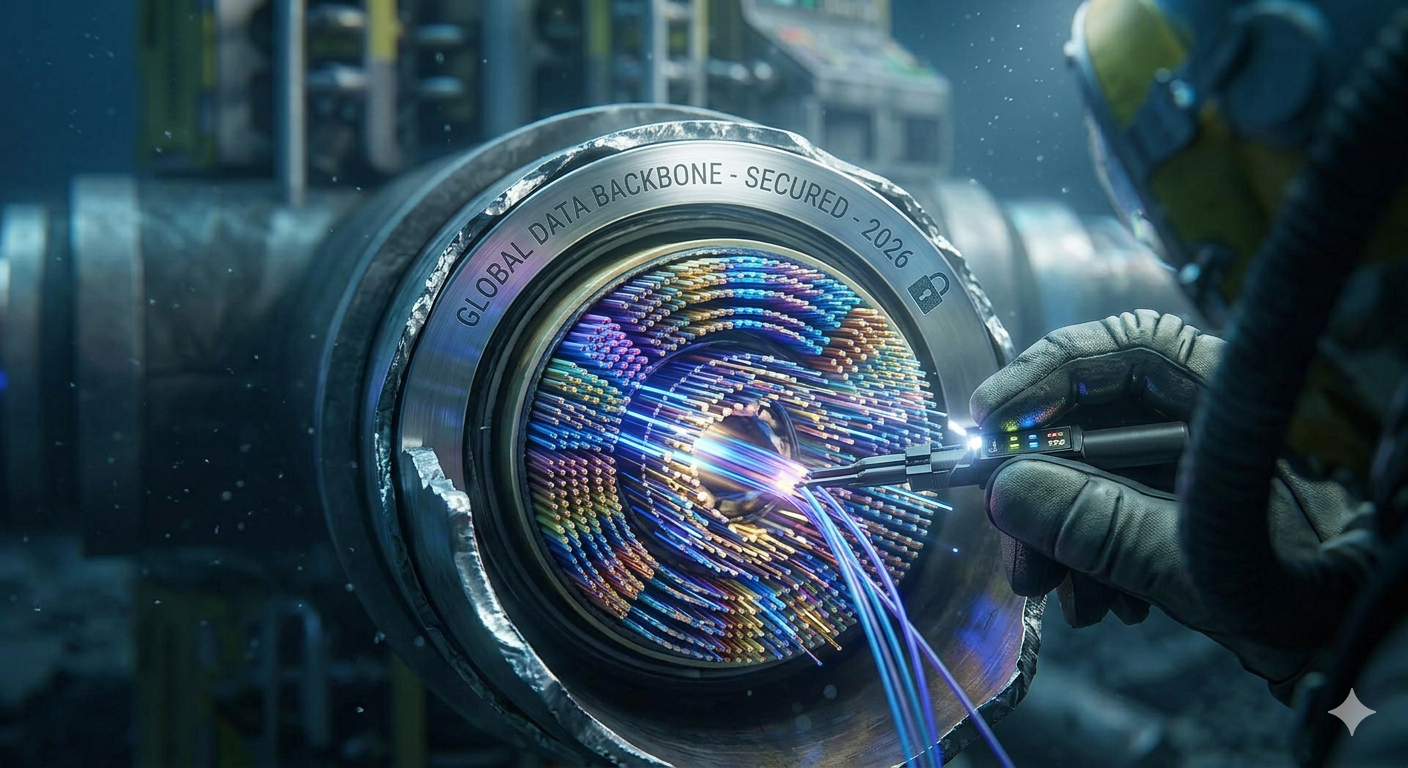
Generated by AI
As the world becomes increasingly reliant on real-time AI and renewable energy, the ocean floor has become the most valuable real estate on Earth. The question for 2026 is no longer if we have enough fiber, but whether we can protect the fragile threads that hold the global economy together.
Vital Infrastructure
A vast, complex web of fiber-optic cables, no thicker than a garden hose, currently carries over 99% of all international data traffic. These are the invisible threads of the deep—a vital infrastructure that facilitates everything from trillion-dollar financial transactions to the real-time processing of Global AI models. As we move further into 2026, the resilience of this subsea network has transitioned from a technical niche to a matter of urgent global stability.
The Lifeblood of the AI Revolution
The recent explosion in Artificial Intelligence has fundamentally shifted the industry’s trajectory. AI is data-hungry, requiring massive bandwidth and ultra-low latency to function across continents. This demand has triggered an unprecedented investment cycle, with subsea infrastructure spending projected to hit $13 billion by next year. No longer content with renting space from telecom providers, "Hyperscalers" like Google, Meta, and Microsoft are now the primary architects of the ocean floor. By owning their own routes, these giants are ensuring that the pulse of the digital world remains steady, even as data volumes grow exponentially.
A Frontier of Geopolitical Friction
Because these cables are the nervous system of the global economy, they have inevitably become "high-value targets" in modern geopolitics. The industry is currently grappling with a "grey zone" of security threats, ranging from accidental anchor drags to sophisticated state-sponsored sabotage. With approximately 200 cable faults reported annually, the focus has shifted from mere installation to active defense. International coalitions, such as the European Commission and the Quad alliance, are now treating these seafloor assets as critical sovereign territory, implementing new monitoring technologies to protect the data streams that sustain modern life.
Engineering Resilience for the Next Decade
Securing the pulse of our digital world also requires a massive scaling of physical resources. The industry is currently facing a "bottleneck" in specialized cable-laying vessels and high-voltage manufacturing. As we integrate more offshore renewable energy into the grid, the demand for submarine power cables is rising alongside fiber-optics. To meet this challenge, leaders like Prysmian and Nexans are pioneering more durable, "armored" cable designs and faster repair protocols. The goal is clear: to build a network that is not only faster but inherently more "self-healing" against the pressures of the deep.
The Fragile Foundation of Modernity
Ultimately, the story of the underwater cable industry is a story of human connectivity versus physical vulnerability. Every video call, every algorithmic trade, and every AI-generated insight relies on the integrity of a few strands of glass resting on the dark ocean floor. As we look toward the horizon, the priority remains the same: safeguarding these invisible threads. By securing the deep, we ensure that the pulse of our interconnected world never skips a beat, maintaining the flow of information that has become as essential to human life as water or power.
Note: AI Disclosure: This document was created and analyzed using Gemini.