
Questions manufacturers should ask AI vendors but rarely do
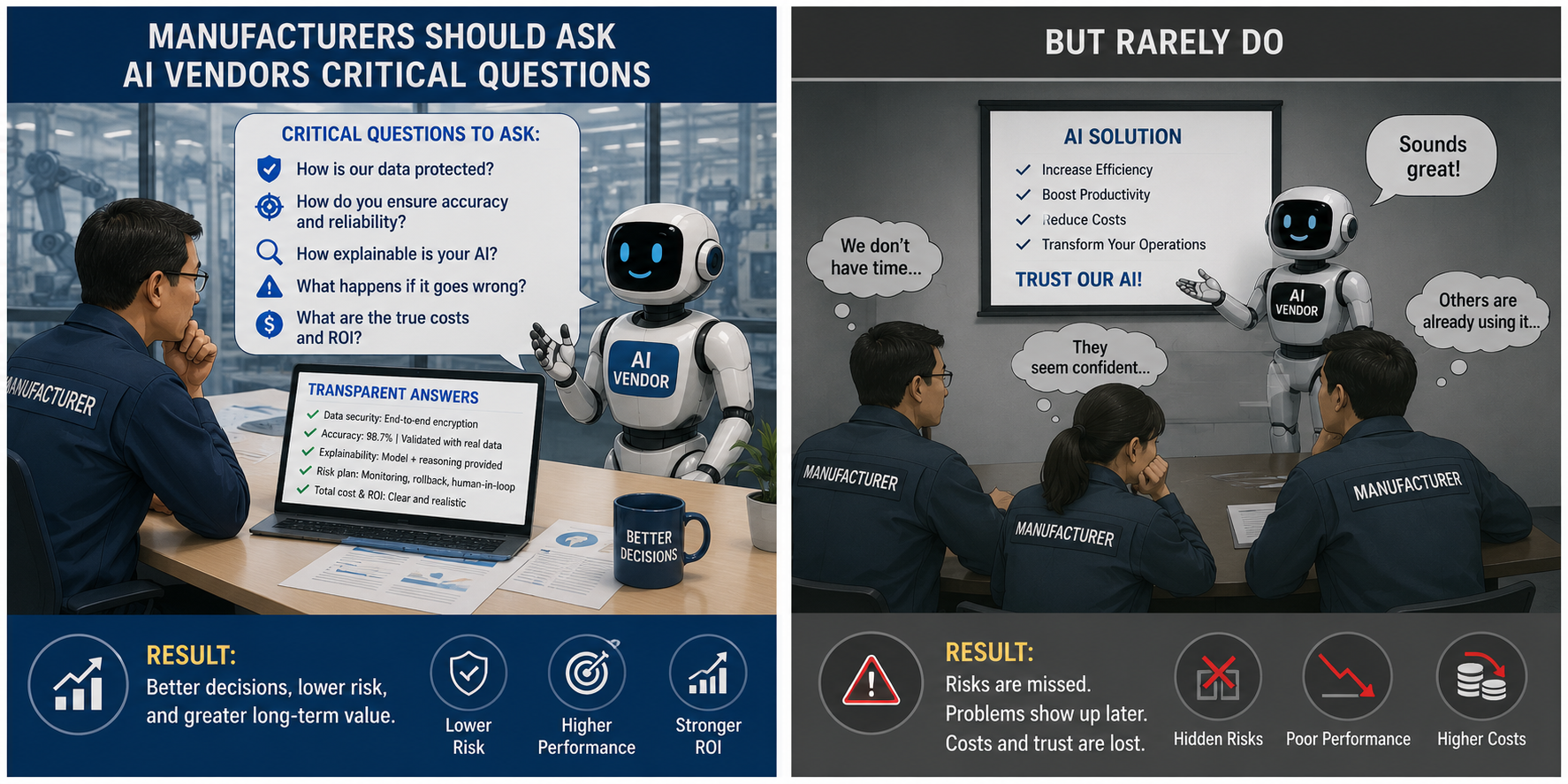
Created by AI
The promise of artificial intelligence in manufacturing is impossible to miss. Optimizing processes such as predictive maintenance, automated quality inspection, production scheduling optimization, engineering copilots and enterprise-wide decision intelligence are all in the offing. Executives are demanding AI strategies from engineers as they fear their company is being left behind.
Beneath all the enthusiasm lies a quiet reality that many manufacturers are evaluating AI purchases using the same criteria traditionally applied to software purchases. They ask about implementation timelines, licensing costs, return on investment and customer references.
Of course those questions matter, but the answers rarely give a glimpse into whether an AI deployment will produce results.
Manufacturers that have successfully implemented AI projects quickly learned deployments are less about algorithms and more about data quality, governance, integration, accountability and long-term operational realities. The most important questions are often the ones buyers never think to ask.
Here are some of those questions every manufacturer should consider before signing an AI contract.
What assumptions are you making about our data?
Every AI vendor says their platform can connect to existing systems. Far fewer explain what must be true about the data flowing through those systems. Is sensor data complete? Are maintenance records consistent? Are operators entering information the same way across shifts and facilities?
Many AI failures are not technology failures at all. The model works as designed, but the underlying data does not. Manufacturers should insist that vendors identify every assumption being made about data quality, completeness and accessibility before deployment begins.
How does the model handle data drift?
Factories are not static environments. As conditions shift, AI models can gradually become less accurate. The danger is that degradation often happens silently and slowly so that a model that was 95% accurate six months ago may now be making significantly more mistakes without anyone noticing.
Manufacturers should ask how performance is monitored, how retraining is handled and whether ongoing model maintenance is included in the contract or billed separately.
What percentage of your customers have reached production scale?
Many AI pilots look impressive, but few become enterprise-wide deployments. Why did the users who did not successfully scale up choose to pull the plug on the project?
The answer often reveals the obstacles vendors rarely highlight during sales presentations, including integration challenges, organizational resistance, insufficient data quality and disappointing returns.
Who owns the intellectual property generated by the model?
This question is becoming increasingly important as AI systems learn from customer-specific environments. The vendor may own the core platform, but the manufacturer provides the operational expertise, process knowledge and proprietary data used to generate insights.
Manufacturers should clarify who owns derived models, custom tuning, generated recommendations and operational insights. They should also ask whether lessons learned from their data can be used to improve products sold to competitors.
What is the total cost of ownership beyond the license fee?
AI projects frequently cost more than expected and licensing may represent only a portion of the overall investment.
Additional costs can include cloud infrastructure, compute resources, storage, data engineering, integration services, cybersecurity reviews, model retraining and internal staffing. Manufacturers should insist on a comprehensive total cost of ownership analysis that extends beyond the initial subscription price and reflects the realities of operating at scale.
Please click HERE to view the original article.