
From Hype to Healing: AI Compresses Drug Discovery Timelines
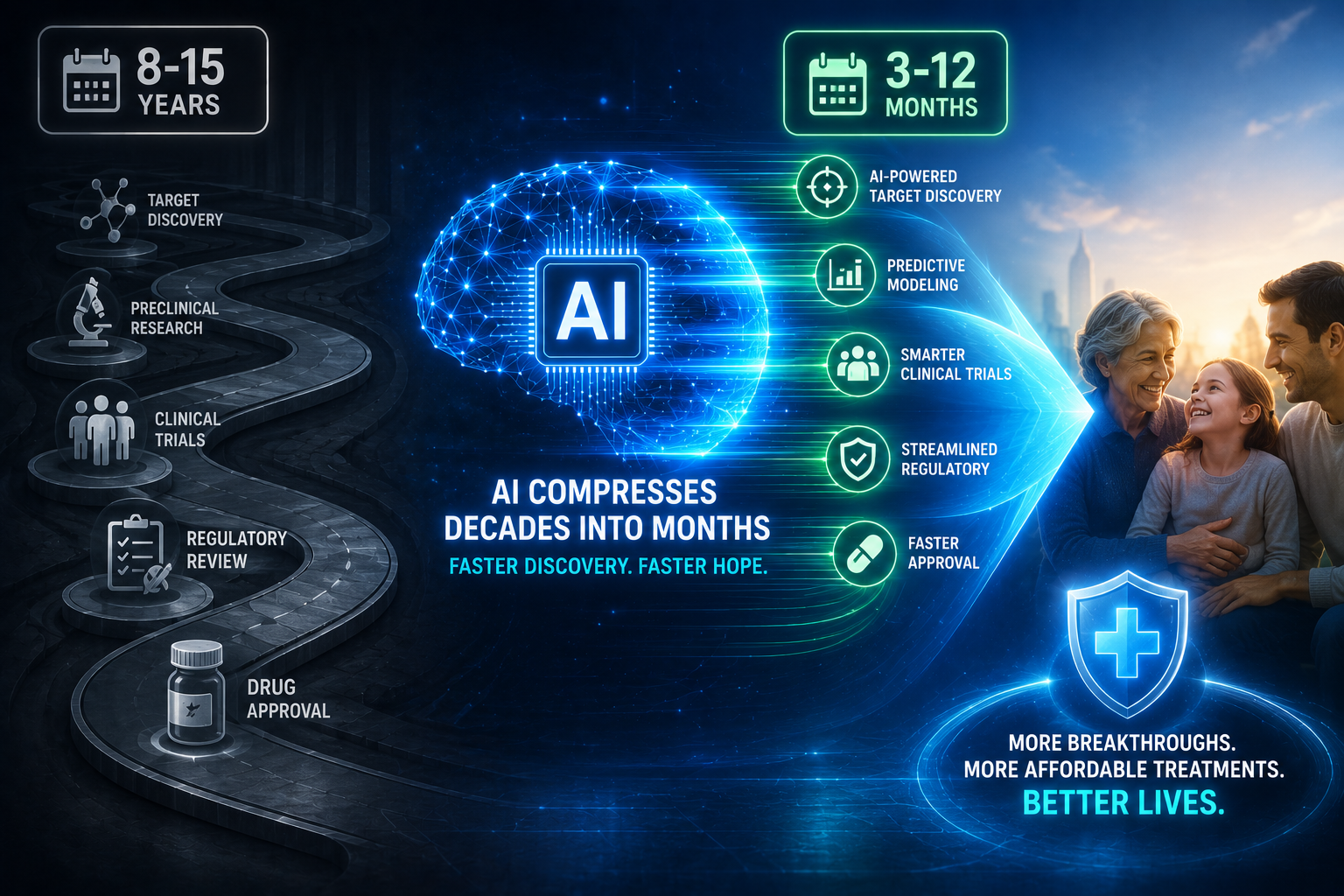
image creatd by chatgpt
The integration of Artificial Intelligence into medical development has officially shifted from theoretical "hype" to massive commercial validation in May 2026. Instead of just screening molecules, AI is now actively compressing drug development timelines from decades to months by managing complete R&D pipelines. [1, 2, 3, 4]
Several major AI-driven medical developments and partnerships are currently catching the attention of the tech and pharmaceutical industries: [5]
De Novo Drug Design Engines & Mega Funding
The scale of capital flowing into pure-play AI biotech platforms has validated them as core industry pillars rather than experimental tech offshoots. [2]
Isomorphic Labs
Spun out of Google DeepMind, Isomorphic Labs shocked the market by raising a massive $2.1 billion Series B round. The capital scales their IsoDDE (AI Drug Design Engine) to transition computer-generated molecular predictions directly into human clinical trial pipelines.
Insilico Medicine
Insilico Medicine is drawing eyes due to its generation-validation ecosystem powered by its Pharma.ai platform. They secured a $2.75 billion global launch partnership with Eli Lilly to deploy fully AI-designed therapies targeting age-related diseases and oncology.
Recursion Pharmaceuticals
In collaboration with Nvidia, Recursion built the pharmaceutical sector's largest AI supercomputer. They are generating significant buzz with LOWE, a natural-language AI agent that allows lab biologists to run complex robotic data simulations using simple voice or text prompts. [6, 7]
Targeted Breakthroughs & Asset Optimization
AI is finding immediate success in revitalizing failing compounds and navigating high-failure medical fields. [4, 8]
Antibiotic Resuscitation: In a massive breakthrough for superbug resistance, a newly deployed AI platform successfully analyzed weak, obsolete antibiotics and predicted specific structural modifications to transform them into potent, drug-resistant pneumonia treatments.
Obesity Small-Molecules:Nimbus Therapeutics has caught the industry's attention by utilizing machine learning simulations to develop highly targeted oral small-molecule treatments for metabolic diseases, earning a $1.3 billion milestone backing from Eli Lilly.
Rare Disease Repurposing: Researchers are utilizing deep learning to screen thousands of existing, approved medications against rare conditions like Leigh syndrome, uncovering novel treatment pathways without needing a 10-year discovery phase. [4, 7, 8, 9]
AI-First Infrastructure & Governance Shifts
The physical and regulatory landscape is rapidly shifting to accommodate AI-generated medicine. [1, 5]
The Physical AI Lab: Eli Lilly and Nvidia announced a joint Co-Innovation AI Lab, uniting silicon engineers and biochemists to develop physical AI robotics designed specifically to automate the physical synthesis and testing of AI-discovered drugs.
Real-Time FDA Pipelines: To keep pace with computational speed, AstraZeneca has begun sharing real-time, AI-streamlined clinical trial data directly with the FDA, bypassing traditional post-trial reporting to shave months off the approval bottleneck. [7, 10]
[1][2][8]drugtargetreview.com
[3] bcg.com
[4]mdpi.com
[5]wolterskluwer.com
[6] biospace.com
[7] builtin.com
[9]medicalexpress.com
[10]medicalfuturist.com